
Introduction
The steam and condensate system is one of the most critical sections of a multi-layer board machine. It directly impacts drying efficiency, energy consumption, and final board quality. In fact, nearly 70–80% of total thermal energy in a paper mill is consumed in the dryer section.
What is a Steam & Condensate System?
The steam and condensate system is responsible for:
- Supplying heat to dryer cylinders
- Removing condensate formed after heat transfer
- Maintaining uniform drying across the machine
“During production, the paperboard sheet enters the dryer section with high moisture (~60–65%) and exits with final moisture around 6–7%.”
How the System Works
The process is based on heat transfer through steam condensation.
Step-by-step operation:
- Steam is generated in the boiler
- It is distributed through the main steam header
- Steam enters dryer cylinders via rotary joints
- Inside the cylinder, steam condenses and releases latent heat
- Heat evaporates moisture from the board
- Condensate and unused steam are removed through syphons
- The mixture goes to separators
- Condensate is returned to the boiler, and flash steam is reused
“This cycle ensures continuous and efficient drying.”
Main Components of the System
1. Steam Supply System
- Boiler and steam header
- Pressure reducing valves (PRVs)
- Steam groups (high, medium, low pressure)
“Each dryer section operates at different pressures to optimize drying.”
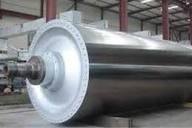
2. Dryer Cylinders (Dryer Cans)
These are large cast iron cylinders heated internally by steam. The board sheet passes over them, and moisture evaporates due to heat transfer.
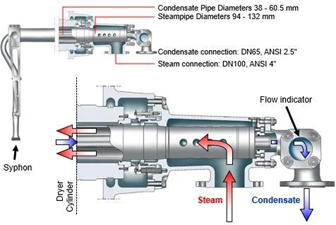
3. Rotary Joints
Rotary joints connect stationary pipelines to rotating dryer cylinders. They allow:
- Steam entry
- Condensate exit
4. Syphon System
Syphons remove condensate from inside the dryer.
Types:
- Stationary syphon
- Rotary syphon
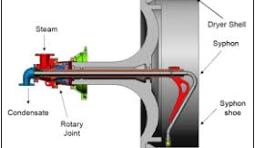
“Efficient condensate removal improves heat transfer significantly.”
5. Separator
Separators divide:
- Condensate (liquid phase)
- Flash steam (vapour phase)
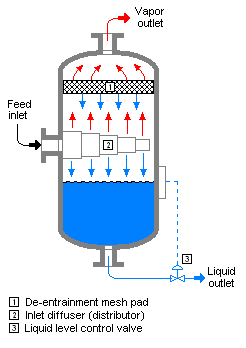
“This is important for steam recovery and system stability.”
6. Condensate Recovery System
- Condensate tanks
- Pumps
- Flash vessels
“Recovered condensate is reused in the boiler, saving energy and water.”
7. Thermo-compressor
A thermos-compressor uses high-pressure steam to recompress low-pressure steam, improving energy efficiency through steam reuse.
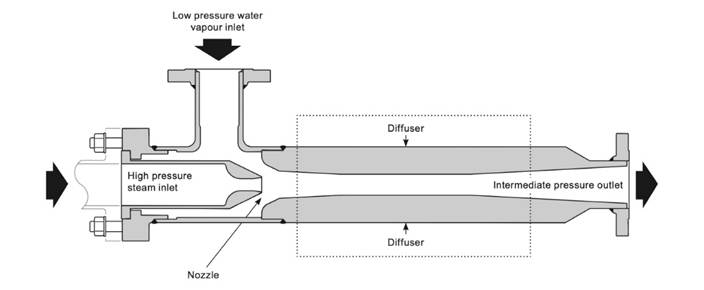
PURPOSE
- Re-circulates flesh Steam
- Independent Steam Group
FUNCTION
- Steam Jet Ejector Principle
- Uses High Pressure Steam
- Recompresses flesh Steam
- Discharges to Group Pressure
- Flesh Control Recommended
Steam System in Multi-Layer Board Machine
A multi-layer board machine typically has multiple dryer sections:
- Pre Dryer Section: Removes bulk moisture after press section
- After Size Press Dryer: Dries sheet after starch or coating application
- Final Dryer Section: Achieves final moisture and surface quality
“Each section operates with independent steam pressure control.”
Steam Cascade System
Modern machines use a cascade system:
- High-pressure steam is used in initial dryers
- Exhaust steam is reused in later dryer groups
“This significantly reduces steam consumption and improves efficiency.”
Condensate Behavior Inside Dryer
The behaviour of condensate depends on machine speed:
- Ponding (low speed) – poor heat transfer
- Puddling – unstable condition
- Cascading – ideal condition
- Rimming (high speed) – high efficiency
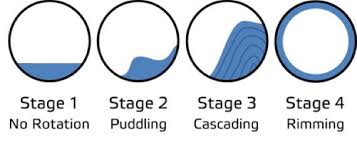
“Maintaining a thin condensate film is critical for efficient drying.”
Key Operating Concepts
- Blow-Through Steam: A small portion of steam (10–20%) is allowed to pass through without condensing.
It helps push condensate out of the dryer. - Differential Pressure (DP): The pressure difference between steam and condensate systems drives condensate removal.
- Flash Steam: When condensate pressure drops, part of it flashes into steam, which can be reused in lower-pressure sections.
Control System in Modern Mills
Advanced systems include:
- Steam pressure control (zone-wise)
- Temperature control for dryer groups
- Condensate level monitoring
- DCS/SCADA automation
“These systems ensure uniform drying and better energy utilization.”
Common Problems and Solutions
- Poor Drying Efficiency
Causes:
- High condensate level
- Improper syphon setting
Solution:
- Check differential pressure
- Adjust blow-through steam
2. Moisture Profile Variation
Causes:
- Uneven temperature distribution
- Condensate removal issues
3. High Steam Consumption
Causes:
- Steam leakage
- Poor insulation
- Inefficient cascade system
4. Water Logging in Dryer
Causes:
- Blocked syphon
- Low pressure difference
Energy Saving Opportunities
- Use thermos compressors
- Optimize blow-through steam (15–20%)
- Improve condensate recovery
- Maintain proper insulation
- Increase press dryness
“Even a 1% increase in press dryness can reduce steam consumption by ~5%”
Practical Operating Tips
- Maintain proper differential pressure (0.3–1.5 bar typical)
- Regularly inspect rotary joints and syphons
- Monitor steam consumption (kg/ton board)
- Ensure proper condensate drainage
- Avoid excessive blow-through steam
Conclusion
The steam and condensate system is the backbone of the dryer section in a multi-layer board machine. Its performance directly affects:
- Production rate
- Board quality
- Energy consumption
A well-optimized system ensures: 1. Efficient drying. 2. Lower energy costs. 3. Stable machine operation