
Introduction
In multilayer board manufacturing (like FBB, SBS, WLC, kraft liner), the coating section plays a critical role in transforming a base sheet into a high-value, print-ready product.
While the base layers (often made with pulps like BCTMP, OCC, or kraft) provide bulk and strength, the coating layer delivers:
- Surface smoothness
- Brightness & whiteness
- Printability
- Barrier properties
In simple terms:
- Base sheet = strength
- Coating = appearance + functionality
1. Purpose of Coating in Board Machines
Key Objectives:
- Improve surface smoothness
- Enhance print quality (ink holdout)
- Increase brightness & opacity
- Provide barrier properties (water, grease)
- Reduce porosity
- Improve visual appeal
2. Position of Coating Section in Machine
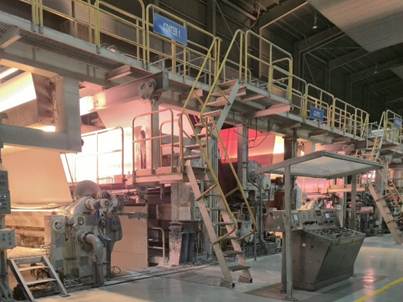
Typical flow:
Forming → Press → Dryer → Size Press → Dryer → Coating→ Drying → Calender → Reel
Coating is usually applied:
- After size press
- On top side only (sometimes both sides depending on grade)
3. Types of Coating Systems
A. Blade Coater
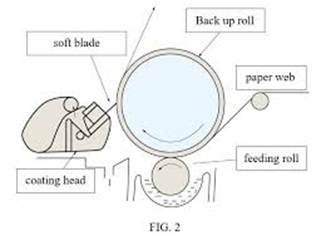
Working Principle:
- Excess coating is applied
- A blade scrapes off extra coating
- Leaves a uniform thin layer
Advantages:
- High smoothness
- Excellent printability
- Precise coat weight control
Limitations:
- Higher cost
- Blade wear issues
Best for: Premium boards (FBB, SBS)
B. Rod (Mayer Rod) Coater
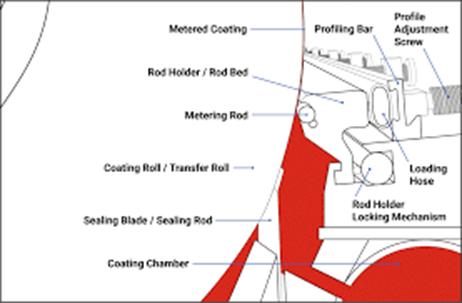
Working Principle:
- A wire-wound rod meters coating
- Controls thickness via rod size
Advantages:
- Simple and cost-effective
- Good for medium quality
Limitations:
- Less smooth than blade coating
Best for: Medium-grade boards
C. Air Knife Coater
Working Principle:
- High-speed air jet removes excess coating
Advantages:
- Good control
- Suitable for uneven surfaces
Limitations:
- High energy consumption
- Noise & mist issues
D. Curtain Coater (Advanced)
Working Principle:
- Free-falling curtain of coating applied uniformly
Advantages:
- Extremely uniform coating
- High-speed operation
Limitations:
- High capital cost
- Sensitive to disturbances
Best for: High-end coated boards
4. Coating Formulation (Critical Part)
A typical coating colour consists of:
A. Pigments (70–80%)
- Clay (kaolin)
- Calcium carbonate (GCC/PCC)
Provide: Smoothness, Brightness and Opacity.
B. Binders (10–20%)
- Latex (SB latex)
- Starch
Provide: Strength and Pigment binding
C. Additives (1–5%)
- Dispersants
- Defoamers
- Optical brightening agents (OBA)
- Lubricants
- Viscosity modifier
- Insolubiliser
Control: Rheology, Foam, Brightness, smooth flow under blade, Viscosity, and wet rub resistant
D. Water (Balance)
- Controls viscosity and flow
5. Key Operating Parameters
| Parameter | Typical Range |
| Coat weight | 8–25 GSM |
| Solids | 55–65% |
| Viscosity | 500–1500 cps |
| Machine speed | 300–1000 m/min |
| Drying temperature | 100–200°C |
6. Drying After Coating
Coating must be dried carefully to avoid defects.
Methods:
- IR dryers (initial drying)
- Hot air dryers
- Cylinder dryers
Important:
- Avoid coating cracks
- Maintain surface quality
7. Common Coating Defects
A. Streaks
- Cause: Blade damage / contamination
- Solution: Blade change, cleaning
B. Orange Peel
- Cause: Poor flow / high viscosity
- Solution: Adjust formulation
C. Picking
- Cause: Weak surface strength
- Solution: Improve size press or binder
D. Cracking
- Cause: Over-drying
- Solution: Optimize drying profile
E. Mottling
- Cause: Uneven absorption
- Solution: Improve base sheet uniformity
8. Practical Insights for Professionals
A. Base Sheet Matters
Even the best coating cannot fix:
- Poor formation
- Uneven moisture profile
B. Balance is Key
- High pigment → better printability
- High binder → better strength
Optimize based on product requirement
9. Application in Multilayer Board
Typical Layer Structure:
- Top layer → Virgin fiber (good surface)
- Middle layers → BCTMP / OCC (bulk)
- Bottom layer → Recycled / kraft
Coating mainly applied on: Top layer for printing and appearance
10. Industry Trends
- Shift toward double/triple coating
- Increased use of functional coatings: 1. Barrier (plastic replacement) 2. Grease-resistant
- Automation & AI-based coat weight control
Conclusion
Coating plays a crucial role in upgrading board from a basic functional product to a premium one. The selection of the coating system depends on factors such as product quality requirements, cost considerations, and machine capabilities. Achieving a high-quality, defect-free surface requires the right combination of formulation and proper operation.
In multilayer board machines, the base sheet provides strength, while coating adds value. An optimized coating section significantly improves product quality, enhances customer satisfaction, and increases overall profitability.