
Introduction
In today’s competitive paperboard industry, coating plays a crucial role in transforming a basic sheet into a high-value product.
Among various coating technologies, the Metering Bar Coater (Rod Coater) stands out as one of the most practical, cost-effective, and widely used solutions—especially in multilayer board machines.
What is a Metering Bar Coater?
A Metering Bar Coater is a coating system based on a simple but effective principle:
Apply excess coating → remove excess → achieve a uniform layer
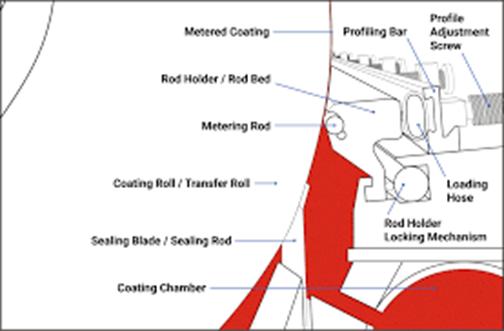
In this system, coating color is first applied generously onto the paperboard surface. A rotating rod (smooth or wire-wound) then meters the coating by removing excess material, leaving behind a controlled and uniform film thickness.
It is widely used in:
- Duplex board manufacturing
- Folding Box Board (FBB)
- Kraft liner and test liner
- Pre-coating and back coating applications
How Does It Work?
The working process can be broken down into five key stages:
1. Coating Preparation: A mixture of pigments (clay, GCC), binders (latex, starch), and additives is prepared.
2. Application: An applicator roll or pan floods the board surface with excess coating.
3. Metering: A rotating rod removes excess coating and controls the final film thickness.
4. Film Formation: A uniform coating layer remains on the sheet.
5. Drying: The coated sheet passes through IR and hot air dryers to solidify the coating.
Key Components of a Rod Coater
A typical metering bar coater consists of:
- Applicator System – Applies coating uniformly
- Metering Rod Assembly – Controls coat weight
- Backing Roll – Supports the sheet
- Drive System – Rotates the rod to avoid streaking
- Color Circulation System – Maintains consistent coating supply
Types of Metering Rods
1. Smooth Rod (Hydrodynamic)
- Works on pressure-based metering
- Suitable for higher speeds
- Better for controlled applications
2. Wire-Wound Rod (Volumetric)
- Coating controlled by wire grooves
- Easy and predictable coat weight control
- Most commonly used in board machines
Key Insight: Larger wire diameter = higher coat weight
Coat Weight Control: What Really Matters?
Controlling coating weight (GSM) is critical for both quality and cost. The main influencing factors include:
- Rod Diameter / Wire Size – Primary control parameter
- Coating Solids (%) – Most sensitive variable
- Machine Speed – Influences coating pickup
- Rod Pressure – Higher pressure reduces coat weight
- Wrap Angle – Affects metering efficiency
Even small changes in solids can significantly impact final coating weight, so consistency is essential.
Where is It Used in a Multilayer Board Machine?
Metering bar coaters are typically used in:
- Pre-Coating a. Creates a smooth base layer b. Reduces top coat consumption
2. Back Coating
a. Improves reverse side properties
b. Enhances printability and appearance
3. Functional Coating
a. Barrier coatings (moisture, grease)
b. Brightness and surface enhancement
Advantages of Metering Bar Coater
- Simple and robust design
- Low capital and operating cost
- Easy to operate and maintain
- Good surface smoothness
- Suitable for a wide range of coating recipes
Limitations You Should Know
- Less precise than blade coaters
- Sensitive to viscosity and solids variation
- Not ideal for high-end top coating applications
- Rod wear can affect consistency
Common Problems and Practical Solutions
- Streaking
Cause: Dirty or worn rod
Solution: Regular cleaning and timely replacement
2. Uneven Coating
Cause: Pressure variation or poor rheology
Solution: Maintain uniform pressure and optimize viscosity
3. Rod Wear
Cause: Abrasive pigments
Solution: Use coated or ceramic rods
4. Splashing or Mist Formation
Cause: High speed with low viscosity
Solution: Adjust coating formulation and operating conditions
Typical Coating Formulation
A standard coating mix may include:
- Pigments: Clay, GCC
- Binders: Latex, starch
- Additives: Dispersants, optical brighteners, rheology modifiers
The exact formulation depends on product requirements and machine conditions.
Best Operating Practices
To get consistent results from your rod coater:
- Maintain coating solids within tight limits (±0.5%)
- Monitor viscosity regularly
- Inspect rods daily for wear and damage
- Ensure proper cleaning to avoid streaks
- Maintain uniform cross-direction pressure
Rod Coater vs Other Coating Technologies
| Parameter | Rod Coater | Blade Coater | Film Press |
| Cost | Low | High | Medium |
| Control | Medium | High | Medium |
| Application | Pre-coat | Top coat | Size coat |
| Surface Finish | Good | Excellent | Moderate |
Final Thoughts
In multilayer board production:
- Base sheet provides strength
- Coating creates value
The Metering Bar Coater plays a crucial role as a foundation coating system, preparing the surface for higher-quality finishing layers.
When properly optimized, it can:
- Reduce coating cost
- Improve surface uniformity
- Enhance overall product quality
- Increase machine efficiency
Conclusion
A Metering Bar Coater may look simply, but its impact on board quality and production economics is significant. By focusing on the right parameters—rod selection, coating formulation, and process control—you can unlock its full potential.