
Introduction
In modern papermaking, achieving the right balance between strength, surface quality, and machine efficiency is critical. One of the most important sections that directly influences these properties is the size press.
Whether you are producing kraft liner board, writing paper, or high-quality printing grades, understanding the difference between Pond Type Size Press and Film Size Press is essential for process optimization and product development.
What is a Size Press?
A size press is a unit located after the drying section of a paper machine where starch or chemical solutions are applied to the paper surface.
Purpose of Size Press:
- Improve surface strength (reduce dusting/picking)
- Increase internal strength (burst, tensile)
- Enhance printability
- Reduce porosity and absorbency
- Improve stiffness and folding endurance
1. Pond Type Size Press (Flooded Nip)
Working Principle
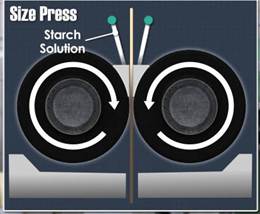
In a pond size press:
- Two rotating rolls form a liquid pond (starch bath) at the nip
- Paper passes through this pond and gets fully immersed
- Excess liquid is squeezed out at the nip
The process is mainly absorption-driven, meaning the sheet absorbs starch into its fiber network.
Key Operating Parameters
- Starch solids: 4–8%
- Nip pressure: 20–50 kN/m
- Pickup: High (6–12% or more)
- Moisture after press: 30–40%
Advantages
1. Deep Penetration
Starch enters fiber structure → improves:
- Internal bonding
- Burst factor
- Compression strength
2. High Strength Development
Ideal for:
- Kraft paper
- Test liner
- Fluting medium
- Coated board
3. Simple Design
- Easy to operate
- Low capital investment
Limitations
1. High Moisture Load
- Requires more steam and drying energy
- Reduces machine efficiency
2. Poor Runnability
- Wet sheet becomes weak → frequent web breaks
3. Low Control
- Pickup depends on:
- Pond level
- Sheet absorption
- Difficult to maintain consistency
4. Speed Limitation
- Not suitable for high-speed machines (>400–500 m/min)
Where It Works Best
- Packaging grades
- High GSM boards
- Machines where strength > surface quality
2. Film Size Press (Metered Size Press)
Working Principle
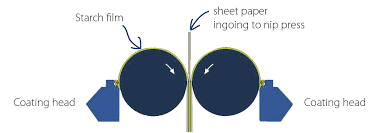
In a film size press:
- Starch is applied as a thin film on applicator rolls
- Metering devices (rod/blade) control film thickness
- Paper passes through nip and receives precise coating
This is a metering-controlled process, not immersion.
Key Operating Parameters
- Starch solids: 8–12% (or higher)
- Pickup: Controlled (2–6%)
- Moisture after press: 15–25%
- Machine speed: Up to 1000+ m/min
Advantages
1. Excellent Coat Weight Control
- Precise and uniform application
- Better product consistency
2. Lower Moisture
- Reduced drying load → energy saving
- Higher machine speed
3. Superior Surface Properties
- Smoothness
- Printability
- Ink holdout
4. Better Runnability
- Stronger web → fewer breaks
5. Flexibility
- Can apply:
- Starch
- Pigments
- Functional chemicals
Limitations
1. Lower Penetration
- Limited improvement in internal strength
2. Higher Complexity
- Requires:
- Metering rods/blades
- Better maintenance
3. Higher Initial Cost
- More advanced system
Where It Works Best
- Writing & printing paper
- Coated grades
- High-speed paper machines
- Premium packaging boards
3. Detailed Comparison
| Feature | Pond Size Press | Film Size Press |
| Application method | Immersion (pond) | Metered film |
| Mechanism | Absorption | Controlled transfer |
| Penetration | Deep | Surface-focused |
| Pickup control | Poor | Excellent |
| Moisture | High | Low |
| Drying energy | High | Low |
| Machine speed | Low | High |
| Runnability | Poor | Excellent |
| Surface quality | Moderate | High |
| Strength improvement | High (internal) | Moderate (surface) |
| Technology | Conventional | Modern |
4. Science Behind the Difference
1. Absorption vs Metering
- Pond Press: Capillary absorption dominates
- Film Press: Controlled film splitting governs application
2. Starch Distribution
- Pond → Internal + surface
- Film → Mainly surface layer
3. Moisture Impact
- High moisture → fiber swelling → weak sheet
- Low moisture → stable sheet → better runnability
5. Industrial Trends
The paper industry is rapidly shifting toward Film Size Press because:
- Higher machine speeds
- Better energy efficiency
- Improved product quality
- Reduced downtime
However, Pond Size Press is still relevant in:
- Low-cost mills
- Heavy-duty packaging grades
6. Selection Guide (Practical)
Choose Pond Size Press if:
- You need maximum strength
- Machine speed is low
- Budget is limited
- Producing kraft/liner/fluting
Choose Film Size Press if:
- You need high surface quality
- Running a high-speed machine
- Energy efficiency matters
- Producing premium grades
7. Common Operational Issues
Pond Size Press
- Foaming in pond
- Sheet breaks due to high moisture
- Uneven pickup
Film Size Press
- Streaks due to rod wear
- Film splitting issues
- Coating non-uniformity
8. Future Outlook
- Film size press evolving into:
- Blade coaters
- Curtain coating systems
- Increasing use of:
- Functional coatings (barrier, grease-proof, water-resistant)
- Integration with smart automation systems
Conclusion
Pond Size Press is ideal for high strength and low-speed applications, but comes with higher moisture and energy costs. Film Size Press offers better surface quality, efficiency, and high-speed performance, making it the preferred modern choice.
Selection depends on your product goals, but the industry trend clearly favors Film Size Press for optimized performance and consistency.