
Introduction
In the paper and paperboard industry, achieving the right balance between surface quality and strength properties is critical. One of the most important finishing tools that directly impacts this balance is the Hard Nip calendar.
What is a Hard Nip calendar?
A Hard Nip calendar is a finishing unit installed at the dry end of a board machine. It consists of two or more hard rolls (steel or chilled cast iron) pressed together under high pressure.
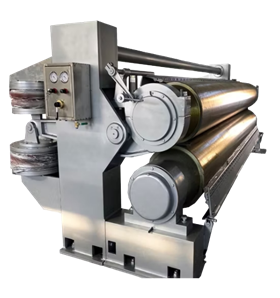
Both rigid rolls are creating:
- A very narrow nip zone
- High linear pressure
- Strong mechanical compression of the sheet
Why is it Important in Multilayer Board?
In a multilayer board machine, different layers serve different purposes:
- Top layer: Surface quality & printability
- Middle layer: Bulk & stiffness (often recycled fiber)
- Back layer: Cost optimization
This variation makes surface finishing challenging.
The Hard Nip calendar helps to:
- Uniformly smooth the top surface
- Improve coating performance
- Enhance printability
- Control final thickness (caliper)
Construction & Key Components
A typical Hard Nip calendar includes:
- Rolls
- Made of steel or chilled cast iron
- Highly polished surface
- Designed to withstand high pressures
2. Nip Loading System
- Hydraulic or pneumatic
- Controls line pressure (kN/m)
3. Frame
- Heavy-duty structure for load stability
4.Drive System
- Synchronized with machine speed
5.Optional Heating
- Steam-heated rolls in some applications
- Oil Heated rolls in Morden machines.
Working Principle
The board passes through the nip between two hard rolls.
What happens inside the nip?
- Fibers are compressed under high pressure
- Surface irregularities are flattened
- Air voids are reduced
- Sheet density increases
Result:
- Improved smoothness
- Reduced thickness
- Better surface uniformity
Position in the Machine
Typical sequence:
Press→ Dryer→ Size Press→ Dryer→ Hard Nip calendar →Coaters →Dryers →SNC → Reel
“It is the final surface finishing step before Coating.”
Controls of HNC
1. Line Pressure (Nip Load) Control
- What it does: Directly compresses the board → reduces caliper
- Control method: Hydraulic or pneumatic loading system
- Impact on profile:
- Higher load → lower caliper
- Uneven load → cross-direction (CD) caliper variation
Best practice:
- Maintain uniform hydraulic pressure across the roll
- Use zoned loading (if available) to correct CD profile
2. Crowned Rolls / Roll Bending System
- Rolls are designed with a crown or controlled bending to compensate deflection
Types:
- Fixed crown rolls
- Variable crown rolls (VC roll)
- Hydraulic bending systems
Why important:
- Without compensation → center becomes thinner, edges thicker
Control action:
- Adjust crown/bending to match:
- GSM profile
- Moisture profile
- Machine speed
Key Operating Parameters
1. Nip Pressure
- Typically: 50–300 kN/m
- Higher pressure → smoother surface, lower caliper
2. Moisture Content
- Ideal: 6–8%
- Too low → cracking
- Too high → over-compression
3. Machine Speed
- Higher speed → less dwell time → reduced effect
4. Number of Nips
- Single nip for basic finish
- Multi-nip for improved surface quality
5. Temperature (if heated)
- Improves fiber plasticity
- Enhances smoothing effect
Effect on Board Properties
| Property | Impact |
| Smoothness | Increases |
| Gloss | Slight increase |
| Caliper | Decreases |
| Density | Increases |
| Stiffness | Decreases |
| Printability | Improves |
Advantages
- Simple and robust design
- Low maintenance requirement
- Suitable for high-speed machines
- Good caliper control
- Long operational life
Limitations
- Reduction in stiffness (bulk loss)
- Limited gloss improvement
- Risk of over-calendaring
- Not ideal for premium coated boards
Hard Nip vs Soft Nip calendar
| Feature | Hard Nip | Soft Nip |
| Roll Type | Hard–Hard | Hard–Soft |
| Nip Width | Narrow | Wide |
| Pressure | High | Moderate |
| Surface Finish | Moderate | Superior |
| Bulk Retention | Low | Better |
| Cost | Lower | Higher |
Operating Best Practices
- Do’s
- Maintain proper moisture (6–8%)
- Monitor nip pressure regularly
- Keep roll surfaces clean
- Ensure proper alignment
2. Don’ts
- Avoid excessive pressure
- Do not run very dry sheet
- Ignore roll wear or damage
Common Problems & Solutions
1. Over-Calendaring
Problem: Low stiffness, excessive thickness reduction
Solution: Reduce nip pressure
2. Uneven Thickness Profile
Problem: CD variation
Solution: Check roll crown and loading system
3. Sheet Cracking
Problem: Low moisture
Solution: Increase moisture before calendar
4. Poor Smoothness
Problem: Insufficient pressure or worn rolls
Solution: Increase load or regrind rolls
Maintenance Guidelines
- Regular roll grinding and polishing
- Hydraulic system inspection
- Bearing lubrication
- Alignment checks
- Surface defect monitoring
Safety Considerations
Hard Nip Calendars operate under extreme pressure, so safety is critical:
- Never approach the nip area during operation
- Ensure safety guards are in place
- Use proper lockout/tagout procedures
- Keep emergency stop systems active
Practical Industry Insights
- Always balance smoothness vs stiffness
- Avoid over-calendaring recycled middle layers
- Combine with size press or coating for best results
- Use profile control systems for uniform caliper
Conclusion
The Hard Nip calendar is a vital finishing tool in a multilayer board machine. While it significantly improves surface quality and printability, excessive use can negatively impact bulk and strength.