
Introduction
Vacuum pumps are essential components in many industrial processes where air, gas, or vapor must be removed to create a controlled pressure environment.
Various types of vacuum pumps used in industry, the Water Ring Vacuum Pump, also known as the Liquid Ring Vacuum Pump, is widely preferred for its reliability, simplicity, and ability to handle wet gases and vapours.
What is Water ring Vacuum pump?
Water ring vacuum pumps are extensively used in industries such as paper and pulp, power generation, chemical processing, pharmaceuticals, mining, and food processing. In the paper and board industry in particular, they play a crucial role in sheet formation, dewatering, and vacuum-assisted drainage systems.
Construction of a Water Ring Vacuum Pump:
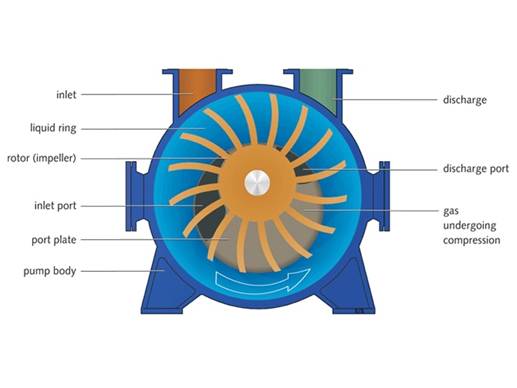
A water ring vacuum pump has a relatively simple mechanical design, which contributes to its reliability and long service life. The main components include:
-
- Cylindrical pump casing
-
- Impeller with radial blades
-
- Suction port
-
- Discharge port
-
- Seal water (operating liquid)
-
- Shaft and bearings
The impeller is mounted eccentrically inside the cylindrical casing. This eccentric mounting is a critical design feature that enables the pump to generate vacuum.
Before operation begins, the pump casing is partially filled with water or another compatible liquid, which acts as the sealing and compression medium.
“The impeller is connected to an electric motor through a shaft and rotates at a constant speed inside the casing.”
Working Principle
The water ring vacuum pump operates on the principle of rotary positive displacement. The pump creates vacuum by continuously expanding and compressing gas-filled chambers formed between the impeller blades and the liquid ring.
The complete pumping cycle consists of five main stages:
-
- Formation of Water Ring
-
- Formation of Gas Chambers
-
- Suction Process
-
- Compression Process
-
- Discharge Process
“These stages occur continuously during each revolution of the impeller.”
1. Formation of Water Ring
When the pump starts:
-
- The casing is partially filled with water.
-
- The impeller rotates eccentrically inside the casing.
-
- Due to centrifugal force, water moves outward and forms a liquid ring along the casing wall.
“This liquid ring creates a crescent-shaped space between the impeller and the water ring.”
2. Formation of Gas Chambers
The impeller blades divide the crescent-shaped space into multiple small chambers.
These chambers change volume as the impeller rotates.
Impeller blades + Water ring = Variable volume chambers
3. Suction Phase
As the impeller rotates, the chamber located near the suction port begins to increase in volume.
The increase in chamber volume causes a reduction in pressure inside the chamber. Since the pressure inside the chamber becomes lower than the pressure in the connected system, air or gas is drawn into the pump through the suction port.
This process creates the vacuum required for the system.
“The gas fills the expanding chamber between the impeller blades and the liquid ring.“
4. Compression Phase
As the impeller continues to rotate, the chamber carrying the gas moves toward the region where the liquid ring is closer to the impeller hub.
In this region, the volume of the chamber gradually decreases because the liquid ring occupies more space between the impeller blades.
The reduction in chamber volume results in compression of the trapped gas.
One of the advantages of water ring vacuum pumps is that the compression process occurs in the presence of liquid, which absorbs heat and maintains nearly isothermal compression conditions. This prevents excessive temperature rise and protects the pump from overheating.
5. Discharge Phase
Once the gas is compressed to a pressure higher than the discharge pressure, it reaches the discharge port.
At this point, the compressed gas is expelled from the chamber and discharged from the pump.
The chamber then continues its rotation toward the suction side again, where the volume begins to increase, and a new suction cycle begins.
“This cycle repeats continuously as long as the pump operates.“
Simplified Conceptual Diagram
The working concept of a water ring vacuum pump can be visualized as follows:

The key mechanism can be summarized as:
Eccentric impeller rotation + liquid ring formation + variable chamber volume = vacuum generation
Operating Liquid (Seal Water)
The liquid used inside the pump serves several important functions:
-
- Forms the sealing ring
-
- Compresses the gas
-
- Absorbs heat generated during compression
-
- Removes contaminants and vapors
Water is the most commonly used liquid due to its availability and good thermal properties. However, in certain applications, other liquids may be used depending on the gas being handled.
“To maintain efficient operation, a continuous supply of seal water is typically required to compensate for losses due to discharge and evaporation.“
Advantages of Water Ring Vacuum Pumps
Water ring vacuum pumps offer several operational advantages, which make them suitable for demanding industrial environments.
1. Ability to Handle Wet Gases
These pumps can handle moist air, vapors, and liquid carryover without damage. This makes them ideal for processes where gas streams contain water or condensable vapors.
2. Isothermal Compression
Since compression occurs in the presence of liquid, the heat generated during compression is absorbed by the liquid. This results in low operating temperatures and safe handling of volatile gases.
3. Simple and Robust Design
The pump has relatively few moving parts, which reduces maintenance requirements and improves reliability.
4. Smooth Operation
Water ring vacuum pumps operate with low vibration and low noise, making them suitable for continuous industrial processes.
5. Resistance to Contamination
The liquid inside the pump acts as a cleaning medium, helping remove contaminants from the gas stream.
Applications in the Paper and Board Industry
In the paper and multilayer board manufacturing process, vacuum systems are critical for efficient sheet formation and water removal.
Water ring vacuum pumps are widely used in the following sections of paper machines:
-
- Couch roll vacuum systems
-
- Flat suction boxes
-
- Low vacuum and high vacuum boxes
-
- Felt suction boxes
-
- Pick-up roll vacuum
-
- Vacuum dewatering systems
These pumps are particularly suitable for paper machines because they can handle air mixed with water droplets, fibers, and vapor without operational problems.
Efficient vacuum generation improves:
-
- Sheet formation quality
-
- Drainage efficiency
-
- Machine speed
-
- Energy efficiency
Operational Considerations
To ensure reliable performance, several factors must be considered during operation:
-
- Adequate seal water supply
-
- Proper pump sizing for required vacuum capacity
-
- Regular inspection of bearings and mechanical seals
-
- Monitoring discharge temperature and pressure
-
- Maintaining clean suction lines to avoid blockages
“Proper operation and maintenance significantly improve pump efficiency, lifespan, and vacuum stability.“
Conclusion
The water ring vacuum pump is one of the most dependable and versatile vacuum generation technologies used in industrial applications. Its simple design, ability to handle wet gases, and stable operation make it particularly valuable in industries such as paper and pulp, chemical processing, and power generation.
By understanding the working principle and operating cycle of the pump, engineers and plant operators can optimize vacuum system performance, improve process efficiency, and ensure reliable operation of critical industrial equipment.
In modern industrial plants, water ring vacuum pumps continue to play a key role in energy-efficient vacuum generation and process optimization.