
Introduction
In modern multilayer board machines, the Top former plays an important role in sheet quality, strength, and productivity. Top former installed after the initial drainage zone on above the filler layer wire.
Top formers are widely applied in the production of FBB, duplex board, linerboard, and carton board.
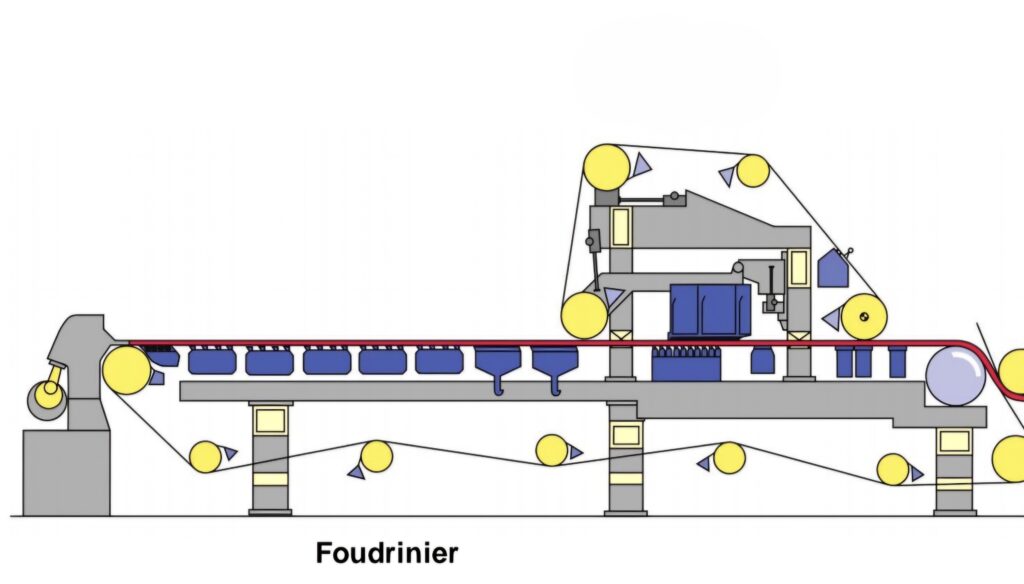
What Is a Top Former?
A Top Former is a twin-wire forming system installed after the initial drainage zone of a Fourdrinier wire. In multilayer board machines, it is commonly used for middle layer formation to improve sheet structure and drainage. The middle layer GSM is around 60% of total board GSM
Top Former Specification
The specifications of a Top Former may vary depending on machine design and supplier, but generally include:
- Former type: Top Former (hybrid twin-wire former)
- Design speed: 300–1200 m/min
- Basis weight range: 60–400 GSM
- Headbox consistency: 0.6–1.2%
- Headbox type: Hydraulic headbox with dilution control
- Forming elements:
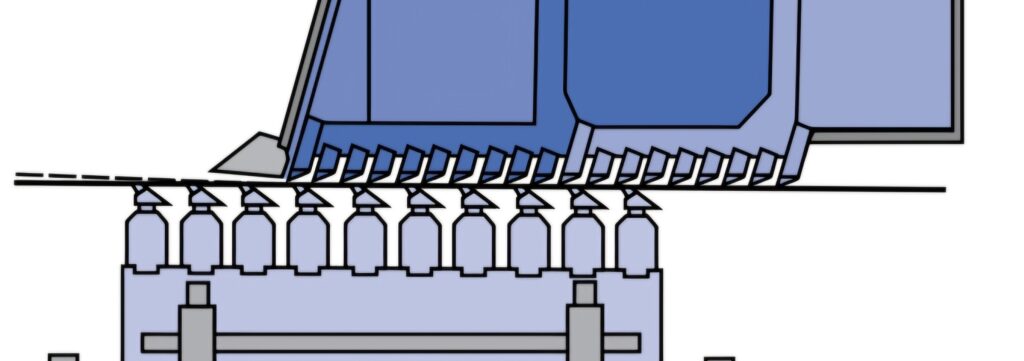
- Vacuum foils
- Top forming box
- Lead-in shoe
- Wire system: Bottom wire + top wire (twin-wire)
- Vacuum range: 10–30 kpa
Working Principle of Duo Former
The working principle of a Top Former is based on controlled two-sided drainage, which improves formation and reduces two-sidedness.
Step-by-Step Process
- Stock from the head box is delivered onto the middle forming wire (Fourdrinier section).
- Initial drainage occurs by gravity and table elements.
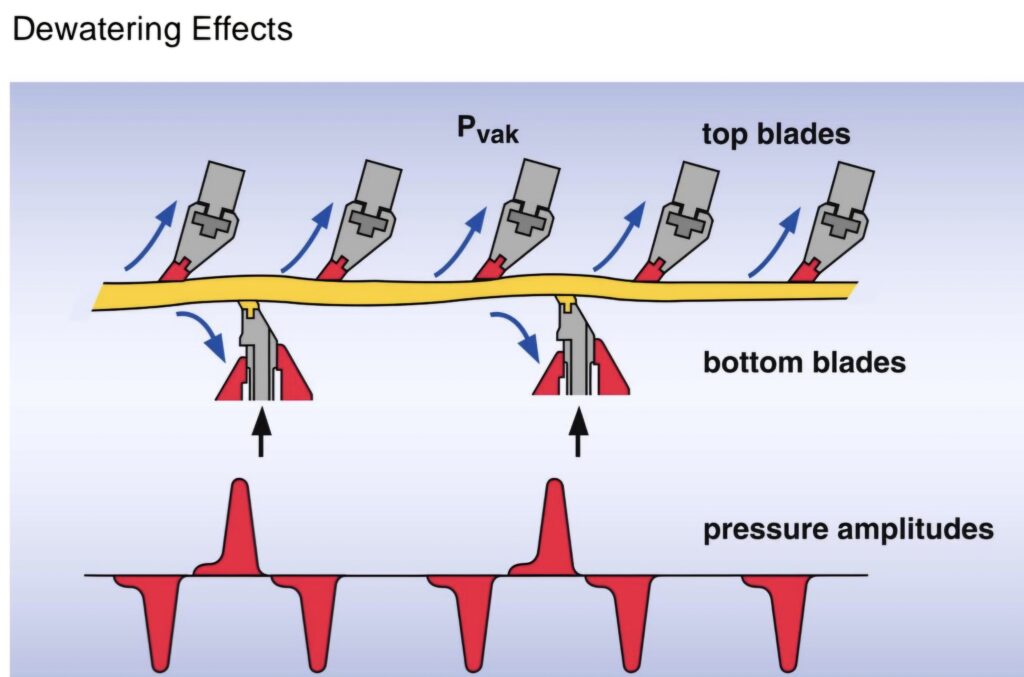
- The top former wire joins the middle wire in the Top Former zone, creating a twin-wire sandwich.
- Dewatering takes place from both sides using vacuum elements.
- Pressure pulses by bottom shoe (bottom Blades) improve fiber distribution and formation.
- The top wire separates, and the sheet continues to the next section.
Vacuum Levels in the Top Former Top‑Wire Suction Box
In a 3‑zone vacuum distribution (Skimmer + Suction Zone 1 + Suction Zone 2):
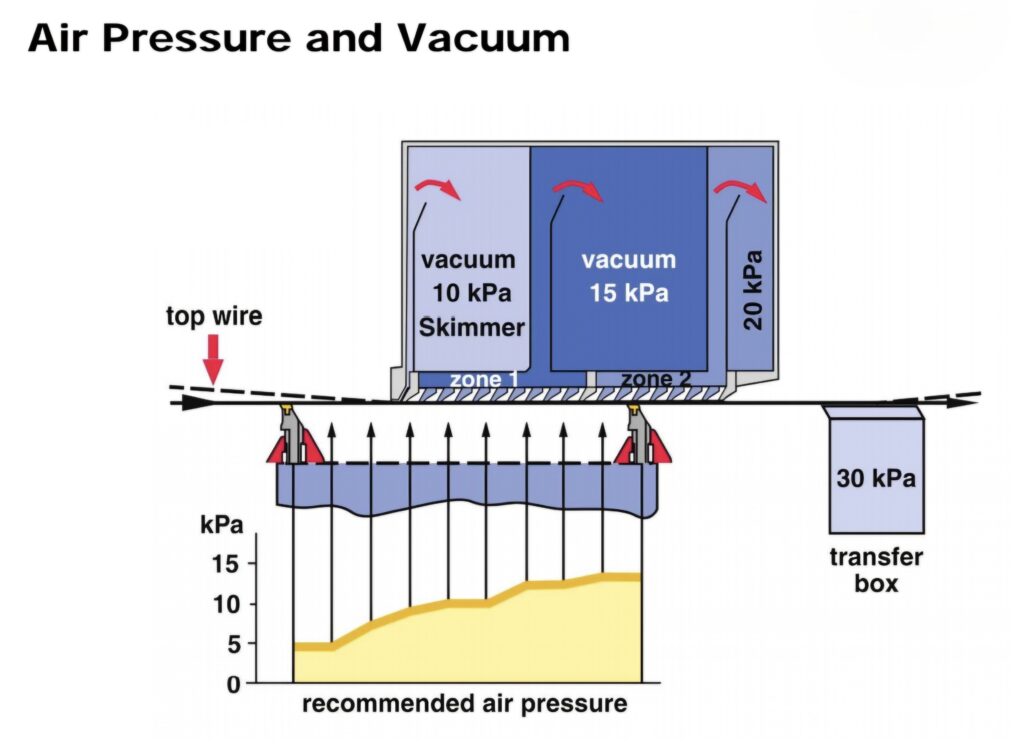
| Zone | Approx. Vacuum (Top‑Wire Suction Box) |
| Skimmer Zone | ~ 10 kPa vacuum (low) |
| Suction Zone 1 | ~ 15 kPa vacuum (medium) |
| Suction Zone 2 | ~ 20 kPa vacuum (higher) |
| Transfer Box (for comparison) | ~ 30 kPa vacuum downstream |
Approximate Dewatering Contribution by Zone
The studies provide dewatering partitioning roughly like this for a Top Former:
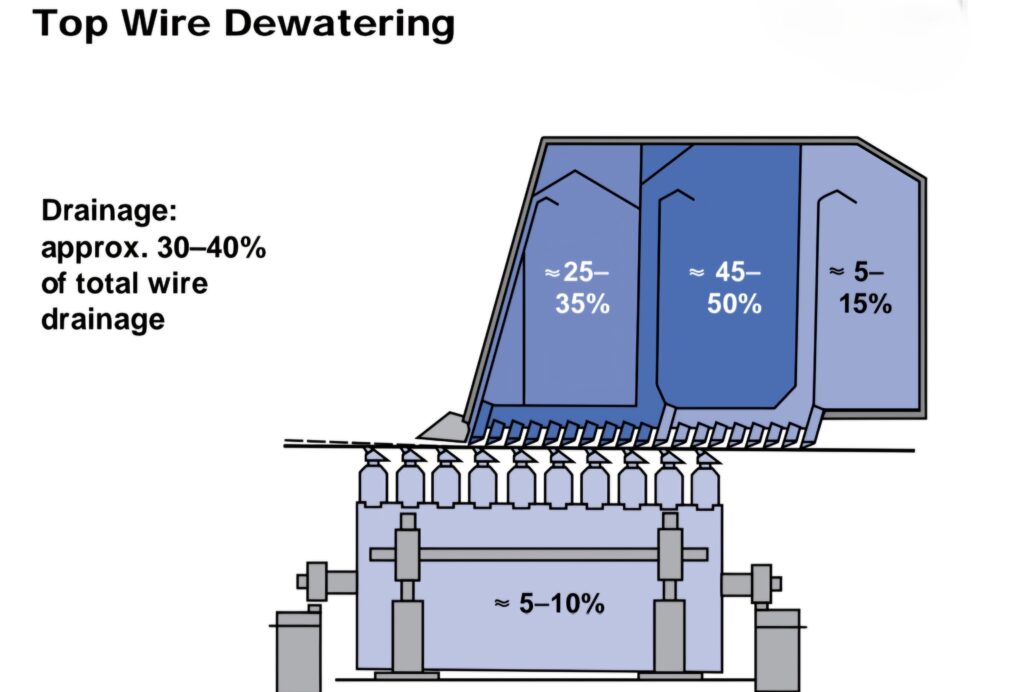
| Zone | Approx. Top Former Dewatering % | Approx. Total Layer Dewatering % |
| Skimmer Zone | ~ 35% | ~ 10–12% |
| Suction Zone 1 | ~50% Majority of remaining dewatering | ~ 16–20% Majority of remaining dewatering |
| Suction Zone 2 | ~ 15% | ~ 4–8% |
| Total Dewatering | ~ 100% of top former water removal | ~ 30 – 40% of total Layer water removal |
What this means in practice
- Skimmer Zone
Very gentle initial water removal right after stock hits the twin‑wire zone. It releases free water from the web surface without compressing it, which helps good formation and minimizes fines loss. - Suction Zone 1
Moderately stronger vacuum begins controlled dewatering while still supporting fiber distribution across the thickness. - Suction Zone 2
Strongest vacuum in the forming section. Most of the water is removed here before the web is strong enough for transfer to press section.
This profile ensures controlled dewatering — avoiding too‑fast initial drainage (which harms formation) but still achieving a good dryness before next section.
Importance of Top Former in Multilayer Board Machine
The Top Former is important because it:
- Improves formation quality of the base sheet
- Reduces two-sidedness
- Enhances retention of fines and fillers
- Improves strength properties
- Supports high-speed operation
- Provides stable sheet structure for additional layers
Advantages of Top Former
Key advantages of using a Top Former include:
- Better formation compared to conventional Fourdrinier
- Uniform GSM and moisture profiles
- Higher retention efficiency
- Improved sheet strength and bonding
- Reduced wire marking
- Stable operation at high speeds
- Suitable for wide GSM range
Disadvantages of Top Former
Some limitations of Top Former are:
- Higher investment compared to single-wire formers
- Increased wire and maintenance cost
- More complex operation
- Requires skilled operators
- Higher vacuum and power consumption
- Limited flexibility compared to full gap formers for very high speeds
Applications of Top Former
Top formers are commonly used for manufacturing:
- Folding Box Board (FBB)
- Duplex board
- Linerboard
- Carton board
- Multilayer packaging boards
Conclusion
The Top Former in a multilayer board machine is a proven and reliable forming technology that bridges the gap between traditional Fourdrinier and advanced gap formers. It offers an excellent balance of quality, productivity, and operational stability,