
Introduction
The shoe press is one of the most important technological upgrades in modern multilayer board machines. Compared to conventional roll presses, a shoe press delivers higher press dryness, better bulk retention, improved strength, and lower energy consumption.
“For high GSM, recycled fiber, and multilayer boards, the shoe press has become the preferred press configuration.”
What Is a Shoe Press?
A shoe press is an extended nip press where the traditional roll nip is replaced by a stationary press shoe acting against a rotating press roll. The shoe creates a long nip zone, increasing the dwell time of the sheet under pressure.
Main Objectives of a Shoe Press:
- Maximize mechanical dewatering
- Preserve bulk and stiffness
- Improve sheet strength and bonding
- Reduce energy consumption in dryers
- Improve machine runnability
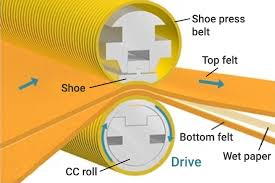
“The key advantage of a shoe press is higher water removal at lower peak pressure,
which protects bulk and sheet structure.”
Why Shoe Press Is Used in Multilayer Board Machines
Multilayer board machines typically operate with:
- High GSM grades
- High recycled fiber content
- High ash and filler loading
Conventional presses reach their limits under these conditions. A shoe press overcomes these challenges by:
- Providing higher dryness
- Improving ply bonding
- Reducing sheet crushing
- Lowering dryer steam consumption
Design of Shoe Press
1. Main Components of Shoe Press
a) Press Shoe
- Stationary curved shoe
- Applies pressure hydraulically
- Designed to match roll curvature
b) Press Roll
- Large-diameter roll
- Covered with polyurethane or rubber
- Rotates against the shoe
c) Shoe Belt (Press Belt)
- Flexible polymer belt
- Runs between shoe and roll
- Transfers pressure uniformly to the sheet
d) Hydraulic Loading System
- Controls press pressure
- Allows zoned or uniform loading
e) Lubrication System
- Oil lubrication between shoe and belt
- Critical for belt life and temperature control
2. Working Principle of Shoe Press (Step-by-Step)
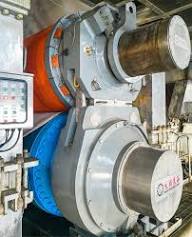
- Wet board sheet enters the shoe press supported by a press felt
- Sheet passes between the press roll and shoe belt
- Hydraulic pressure loads the shoe against the roll
- Extended nip provides long dwell time
- Water is squeezed gradually into the press felt
- Felt carries water to suction and Uhle boxes
- Sheet exits the shoe press with high dryness and intact structure
“Dewatering is mechanical, not thermal.”
Nip Characteristics: Shoe Press Vs Roll Press
| Parameter | Roll Press | Shoe Press |
| Nip length | 30–60 mm | 250–400 mm |
| Dwell time | Short | Long |
| Peak pressure | Very high | Lower |
| Bulk retention | Poor–moderate | Excellent |
| Dryness | Moderate | High |
Press Felts Used in Shoe Press
Preferred Felt Types:
- Triple-layer felts
- Laminated or seam felts (machine dependent)
Key Felt Properties:
- High void volume
- High compressibility
- Resistance to high temperature and pressure
- Excellent dewatering recovery
Typical Operating Parameters of Shoe Press
| Parameter | Typical Range |
| Press outlet dryness | 45–50% |
| Line load | 800–1,200 kN/m |
| Nip length | 250–400 mm |
| Felt vacuum | 40–70 kPa |
| Belt temperature | Controlled via oil system |
Advantages of Shoe Press
1. Higher Press Dryness
- 3–6% higher dryness vs conventional presses
- Direct reduction in dryer steam consumption
2. Excellent Bulk Retention
- Lower peak pressure protects fiber structure
- Higher stiffness at same GSM
3. Improved Ply Bonding
- Uniform pressure improves interlayer bonding
- Ideal for duplex and triplex boards
4. Energy Savings
- Less steam usage in dryer section
- Lower overall production cost
5. Better Runnability
- Fewer breaks
- Stable operation at high speed and high GSM
Disadvantages of Shoe Press
1. High Capital Cost
- Higher investment compared to roll presses
2. Higher Maintenance Skill Required
- Shoe belt and lubrication system need expertise
3. Sensitive to Felt & Belt Condition
- Poor felt condition reduces efficiency quickly
4. Oil Contamination Risk
- Lubrication oil leakage can cause sheet defects if not controlled
Shoe Press Vs Double Felted Jumbo Press
| Parameter | Double Felted Jumbo Press | Shoe Press |
| Nip type | Short nip | Extended nip |
| Press dryness | 40–45% | 45–50% |
| Bulk retention | Moderate | Excellent |
| Energy efficiency | Moderate | High |
| Capital cost | Lower | Higher |
Optimization Tips for Shoe Press in Board Machines
- Select felts designed specifically for shoe press
- Maintain correct hydraulic pressure profile
- Monitor shoe belt temperature and wear
- Ensure effective felt cleaning and conditioning
- Avoid over-pressing to protect bulk
Common Shoe Press Problems and Causes
| Problem | Likely Cause |
| Low press dryness | Dirty felts, low vacuum |
| Bulk loss | Excessive loading |
| Felt wear | Improper belt lubrication |
| Oil spots | Belt or seal leakage |
| Sheet crushing | Incorrect pressure profile |
Applications of Shoe Press
Shoe presses are ideal for:
- Multilayer board machines
- Duplex and triplex boards
- High GSM recycled fiber grades
- Boards requiring high bulk and stiffness
Conclusion
The shoe press is the most efficient press technology for modern multilayer board machines. By combining long nip dwell time with low peak pressure, it delivers higher dryness, better bulk, stronger boards, and lower energy consumption.
“Although capital and maintenance requirements are higher, the long-term gains in productivity, quality, and cost savings make shoe press technology a smart investment.“