
Introduction
In a multilayer board machine, the press section is the most critical zone for mechanical dewatering, sheet consolidation, bulk development, and energy efficiency. A well-designed and well-operated press section directly influences dryer steam consumption, board strength, surface quality, and machine runnability.
Due to high GSM grades, recycled fiber usage, and multiple plies, the press section of a multilayer board machine must be robust, flexible, and precisely controlled.
What Is the Press Section in a Multilayer Board Machine?
The press section is located between the forming (wire) section and the dryer section. Its primary function is to remove water from the wet web by mechanical pressure, using press rolls, felts, and vacuum systems.
Sheet Dryness:
- At wire section outlet: 18–22% (Before Press Section)
- At press section outlet: 42–50% (multilayer board)
“Mechanical dewatering in the press section is far more energy-efficient than thermal drying.”
Objectives of the Press Section
The press section in a multilayer board machine is designed to:
- Remove maximum water mechanically
- Increase sheet density and fiber bonding
- Improve ply-to-ply consolidation
- Reduce dryer steam demand
- Maintain bulk and stiffness
- Ensure stable sheet transfer and runnability
Importance of Press Section in Multilayer Board Production:
Multilayer board machines run with:
- High recycled fiber content
- High ash and filler loading
- Heavy GSM and high bulk grades
An inefficient press section results in:
- High steam consumption
- Poor bonding and strength
- Sheet crushing or bulk loss
- Frequent breaks and downtime
“A well-optimized press section balances dryness, bulk, and strength.”
Types of Press Configurations Used in Multilayer Board Machines
1. Suction Press
A Suction press with two felt, Top side solid rubber roll and Bottom Suction Roll:
Applications
- First press or pickup press
- Lower nip pressure
- Vacuum in Bottom Roll
2. Jumbo Press
The Jumbo press with two felts and both solid rubber rolls with blind Drilled.
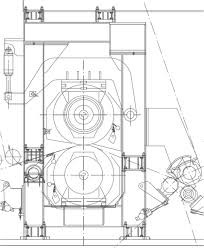
Advantages
- Higher water removal
- Better sheet support
- Reduced two-sidedness
“Widely used for high GSM board grades.”
3. Shoe Press (Extended Nip Press)
The most preferred press for modern multilayer board machines.
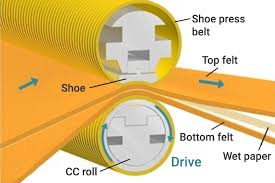
Advantages
- Long nip residence time
- Higher dryness gain
- Better bulk retention
- Lower peak pressure compared to roll press
“Typical press dryness after shoe press: 45–50%”
4. Tandem Press Arrangement
Multiple presses arranged in series (1P, 2P, 3P).
Purpose
- Gradual and controlled dewatering
- Improved consolidation
- Reduced sheet damage
Press Felts: The Backbone of the Press Section
- Functions of Press Felts
- Absorb and transport water
- Support the wet sheet
- Protect sheet surface
- Distribute pressure uniformly
- Felt Types Commonly Used
- Single-layer felts
- Double-layer felts
- Triple-layer felts (preferred for multilayer board machines)
- Felt Properties
- Permeability
- Void volume
- Compressibility
- Chemical and abrasion resistance
Press Loading and Nip Pressure
- Line Load Values
- Conventional roll press: 80–150 kN/m
- Shoe press: 800–1,200 kN/m (distributed load)
- Impact of Incorrect Press Loading
- Low pressure → poor dryness
- Excessive pressure → sheet crushing, bulk loss, felt wear
“Correct loading is critical for balancing dryness vs board bulk.”
Press Section Showers and Felt Conditioning
- Types of Showers Used
- Flood showers
- Lubrication showers
- High-pressure felt cleaning showers
- Purpose of Felt Conditioning
- Maintain felt permeability
- Prevent filler, pitch, and starch deposition
- Extend felt life
- Improve press efficiency
“Chemical dosing through press showers is common in multilayer board machines.”
Working Principle of Press Section (Step-by-Step)
- Wet sheet enters press section on pickup felt
- Sheet passes through successive press nips
- Mechanical pressure squeezes water from the sheet
- Water is absorbed into press felts
- Felts release water through Uhle boxes and suction systems
- Cleaned felts return to the next nip
- Sheet exits press section with high solids content
“The press section works on mechanical dewatering, not heat.”
Key Operating Parameters of Press Section
| Parameter | Typical Range |
| Inlet dryness | 18–22% |
| Outlet dryness | 42–50% |
| Felt vacuum | 30–60 kP a |
| Press loading | Grade dependent |
| Nip temperature | Near ambient |
Common Press Section Problems and Root Causes:
| Problem | Likely Cause |
| Low press dryness | Dirty felts, low nip load |
| Loss of bulk | Excessive press pressure |
| Shadow or crush marks | Worn felts, uneven loading |
| Sheet picking | Poor felt conditioning |
| High steam consumption | Inefficient press dewatering |
Optimization Tips for Multilayer Board Machines
- Use shoe press for high GSM and recycled grades
- Select felts based on furnish and ash content
- Maintain an effective felt cleaning program
- Balance press loading to protect bulk
- Monitor felt permeability and life trends
Impact of Press Section on Final Board Properties
The press section directly affects:
- Bulk and stiffness
- Ply bonding strength
- Surface smoothness
- Drying efficiency
- Overall machine productivity
Conclusion
The press section of a multilayer board machine is the most cost-effective and influential dewatering stage. When properly designed and optimized, it delivers higher dryness, lower energy cost, stable runnability, and consistent board quality.
“Ignoring press section optimization leads to increased operating cost, quality issues, and reduced machine efficiency.”