
Introduction
In today’s competitive paperboard industry, achieving superior surface quality while maintaining high machine speeds is a constant challenge. One of the most critical technologies that helps board manufacturers meet these objectives is the Infrared (IR) Heater Drying System installed in the coating section of a multilayer board machine.
Whether producing Folding Box Board (FBB), White Top Kraft liner (WTKL), or Duplex Board, an efficient IR drying system can significantly improve coating quality, production efficiency, and energy utilization.
What is an IR Heater Drying System?
An Infrared (IR) Heater Drying System is a non-contact drying technology that uses infrared radiation to rapidly remove moisture from the freshly applied coating layer before the sheet enters the conventional drying section.
Unlike conventional hot-air dryers that transfer heat through convection, IR heaters transfer energy directly to the coating and board surface through radiation, enabling much faster and more efficient drying.
The typical drying sequence in a modern board machine is:
Coater → IR Dryer → Air Flotation Dryer → Cylinder Dryer
Why is IR Drying Required After Coating?
Freshly applied coating contains a significant amount of water that must be removed quickly without disturbing the coating structure.
The key objectives of IR drying include:
-
- Rapid surface moisture removal
-
- Prevention of coating migration
-
- Reduction of binder migration
-
- Improved coating holdout
-
- Better gloss and smoothness
-
- Enhanced printability
-
- Increased machine speed
-
- Reduced load on downstream dryers
Without proper drying control, coating defects such as mottling, dusting, uneven gloss, and poor print performance can occur.
How Does an IR Dryer Work?
IR heaters emit electromagnetic radiation in the infrared spectrum. When this radiation strikes the coated surface, it is absorbed and converted into thermal energy.
This process rapidly increases the temperature of the coating layer, causing water to evaporate quickly.
The major advantage is that energy is delivered directly to the coating layer and start drying from the contact point of applied coating and board surface.
“In IR drying, moisture evaporation occurs primarily from the side exposed to the IR heater, while in conventional cylinder drying, moisture migrates through the board thickness and evaporates from the exposed surface.”
Types of IR Heaters Used in Board Machines
1. Gas-Fired IR Heaters
Gas-fired infrared systems utilize natural gas or LPG burners to generate infrared radiation.
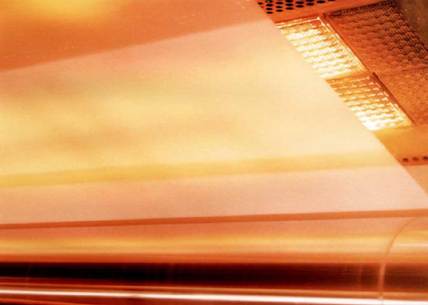
Gas Fired IR
Advantages:
-
- Lower operating costs
-
- High drying capacity
-
- Suitable for high-speed board machines
-
- Excellent energy efficiency
Limitations:
-
- Requires gas infrastructure
-
- Higher maintenance requirements
-
- Combustion control is critical
Typical emitter temperatures range from 800°C to 1000°C.
2. Electric IR Heaters
Electric IR dryers use electrically heated emitters or ceramic elements to generate infrared radiation.
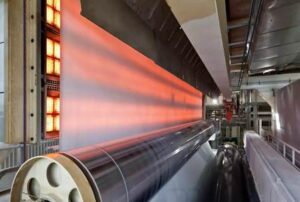
Advantages:
-
- Fast response time
-
- Precise control
-
- Easy installation
-
- Uniform heat distribution
Limitations:
-
- Higher energy costs
-
- Greater electrical load
Typical emitter temperatures range from 700°C to 1800°C depending on the design.
Key Factors Affecting IR Drying Performance
-
- Machine Speed
As machine speed increases, the available drying time decreases.
Higher speeds require:
-
- Increased IR power density
-
- Better moisture control
-
- Optimized dryer configuration
2. Coat Weight
Heavier coat weights contain more water and therefore require greater drying capacity.
Typical coating weights are:
-
- Pre-Coat: 8–12 GSM
-
- Top Coat: 8–18 GSM
-
- Double Coating: 15–30 GSM
3. Coating Solids
Higher coating solids reduce the amount of water that must be evaporated.
Most board coating formulations operate between 58% and 65% solids.
4. Board Basis Weight
Higher GSM boards generally require careful moisture balancing to prevent curl and moisture profile variations.
Benefits of IR Drying in Multilayer Board Manufacturing
-
- Improved Surface Quality
Fast drying stabilizes the coating layer and improves:
-
- Smoothness
-
- Gloss
-
- Printability
-
- Ink holdout
2. Reduced Binder Migration
When drying occurs too slowly, latex and binders can migrate toward the surface.
IR drying rapidly “locks” the coating structure, reducing migration-related defects.
3. Higher Machine Speeds
Many mills report production increases of 5–15% after optimizing IR drying performance.
4. Energy Savings
Effective moisture removal at the coating station reduces the load on:
-
- Air dryers
-
- Steam cylinders
-
- Ventilation systems
5. Better Moisture Profile Control
Modern zoned IR systems help maintain uniform moisture across the machine width.
Common Problems Associated with IR Drying
-
- Coating Cracks
Possible causes:
-
- Excessive IR intensity
-
- Low coating solids
-
- Over-drying of the coating surface
2. Blistering
Possible causes:
-
- Excessive heat input
-
- High incoming moisture
-
- Steam trapped within the board structure
3. Curl Formation
Possible causes:
-
- Uneven drying across the sheet
-
- Excessive edge drying
-
- Moisture imbalance between top and bottom surfaces
4. Coating Dusting
Possible causes:
-
- Binder migration
-
- Insufficient coating consolidation
-
- Improper drying profile
5. Mottling
Possible causes:
-
- Non-uniform drying
-
- Uneven moisture profile
-
- Inconsistent IR power distribution
Best Practices for Operating an IR Drying System
-
- Maintain Proper Coating Solids: Higher coating solids reduce drying demand and improve efficiency.
- Avoid Over-Drying: Excessive surface drying can create coating defects and increase curl tendencies.
- Monitor Sheet Temperature: Continuous temperature monitoring helps maintain consistent drying conditions.
- Optimize IR and Air Dryer Balance: IR dryers should remove initial moisture rapidly, while air dryers complete the drying process efficiently.
- Use Zoned Control: Cross-machine profile control improves moisture uniformity and board quality.
Regular Maintenance
Maintain: 1. Emitters, 2. Reflectors, 3. Sensors, 4. Burner systems, 5. Control loops.
Clean equipment ensures maximum drying efficiency and uniformity.
Future Trends in IR Drying Technology
The latest generation of IR drying systems incorporates:
-
- Automated moisture profile control
-
- AI-based drying optimization
-
- Real-time energy monitoring
-
- Integrated quality control systems
-
- Advanced zoned drying technology
These innovations help mills achieve higher productivity while reducing energy consumption and operating costs.
Conclusion
The IR Heater Drying System has become an essential component of modern multilayer board manufacturing. By providing rapid and controlled moisture removal immediately after coating, IR dryers improve coating quality, reduce defects, increase machine speed, and enhance overall process efficiency.
For paperboard manufacturers seeking higher productivity and superior board quality, optimizing IR drying performance is one of the most effective ways to improve coating operations and achieve sustainable manufacturing excellence.