
Introduction
In the manufacturing of high-quality paperboard, achieving the right balance between strength, surface properties, and cost efficiency is crucial. One of the most important sections that directly influences these properties is the Size Press.
What is a Size Press?
A Size Press is a unit in a paper or board machine where a starch-based solution (size) is applied to the surface of the sheet.
It is typically located:
- After the dryer section
- Before the calendar
Main Objectives:
- Improve surface strength
- Enhance printability
- Increase stiffness
- Control porosity
- Reduce dusting
Working Principle
The sheet passes through a nip formed by two rotating rolls, where the size solution is applied.
Basic Steps:
- Sheet enters the nip
- Size solution is transferred onto the sheet
- Excess solution is controlled or removed
- Sheet exits and goes to drying section
“The effectiveness depends on nip pressure, viscosity, and machine speed.”
Types of Size Press
1. Conventional Pond Size Press
In this system, rolls are partially immersed in a starch solution.

Advantages:
- Simple design
- Low investment
Limitations:
- High moisture addition
- Limited control over pickup
- Not suitable for high-speed machines
2. Film Size Press (Modern Technology)
This system uses applicator rolls and metering rods to apply a controlled thin film.
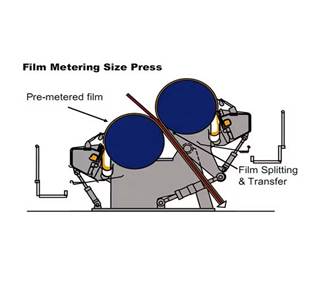
Advantages:
- Precise pickup control
- Lower moisture addition
- Suitable for high-speed machines
Limitations:
- Higher initial cost
- Requires skilled operation
3. Gate Roll Size Press
A controlled film is formed between two rolls and transferred to the sheet.
Best suited for:
- High-speed board machines
- Uniform coating applications
Chemicals Used in Size Press
Primary Component:
- Starch (native or modified)
Common Additives:
- Optical Brightening Agents (OBA)
- Surface Sizing Agent (external sizing support)
- Enzymes (viscosity control)
- Strength Chemicals (If required)
Key Process Parameters
1. Starch Concentration
- Typically: 6–12%
- Higher concentration → higher pickup → better strength
2. Viscosity
- Controls penetration and film formation
- Too high → poor levelling
- Too low → insufficient coating
3. Nip Pressure
- High pressure → deeper penetration
- Low pressure → more surface coating
4. Machine Speed
- Higher speed → lower pickup
- Lower speed → higher pickup
5. Temperature
- Typically, 60–90°C
- Ensures proper starch gelatinization
6. Pickup (GSM)
- Amount of size applied per square meter
Directly affects:
- Strength
- Printability
- Production cost
Role in Multilayer Board Machine
In a multilayer board structure:
- Top Layer: Print quality
- Middle Layers: Bulk and stiffness
- Bottom Layer: Strength
The size press mainly enhances:
- Surface strength of the top layer
- Overall board stiffness
- Surface uniformity for coating and printing
Common Problems & Troubleshooting
| Issue | Possible Cause | Solution |
| Uneven coating | CD profile variation | Adjust flow & metering system |
| Streaks | Dirty rod or roll | Clean regularly |
| High moisture | Excess pickup | Reduce concentration |
| Foam formation | Chemical imbalance | Use defoamer |
| Low strength | Low starch pickup | Increase dosage |
| Sheet breaks | High nip pressure | Optimize load |
Best Operating Practices
- Maintain uniform CD profile before size press
- Ensure proper starch cooking quality
- Clean applicator rolls and rods regularly
- Control bacterial growth using biocides
- Monitor pickup and moisture continuously
- Align size press settings with machine speed changes
Size Press vs Coating: Quick Comparison
| Feature | Size Press | Coating |
| Purpose | Strength & basic surface | High-end print quality |
| Cost | Lower | Higher |
| Control | Moderate | High |
| Application | Starch-based | Pigment-based |
Advanced Insights for Professionals
- Penetration vs Film Formation depends on viscosity and base sheet porosity
- Film thickness is controlled by rod/blade geometry
- Strong interaction exists between:
- Size press
- Dryer section
- Callender
A small change in size press can significantly impact:
- Calliper
- Smoothness
- Print performance
Conclusion
The size press is not just a chemical application unit—it is a critical quality control point in a multilayer board machine.
A well-optimized size press operation ensures:
- Better product quality
- Improved machine efficiency
- Reduced production cost