
What is wire Section:
The wire section (forming section) is the first section of the board machine where stock from different head boxes (Top / Middle / Back layers) is deposited, water is drained, and a multi-ply wet web is formed with proper layer integrity, formation, and strength.
The wire part is designed to:
- Form separate layers
- Combine them without intermixing
- Achieve high dewatering capacity
- Maintain bulk, stiffness, and bonding
Configurations in Multi-Layer Board Machines:
A. Multi-Fourdrinier Configuration
“Used in older / medium-speed board machines)’
Arrangement
- Separate Fourdrinier wires for each layer
- Layers are couch-pressed together sequentially
Example: Back layer → Middle layer → Top layer
Advantages
- Simple design
- Easy layer control
Limitations
- Large space requirement
- Lower speed
- Higher energy consumption
B. Hybrid Former Configuration with Top Former
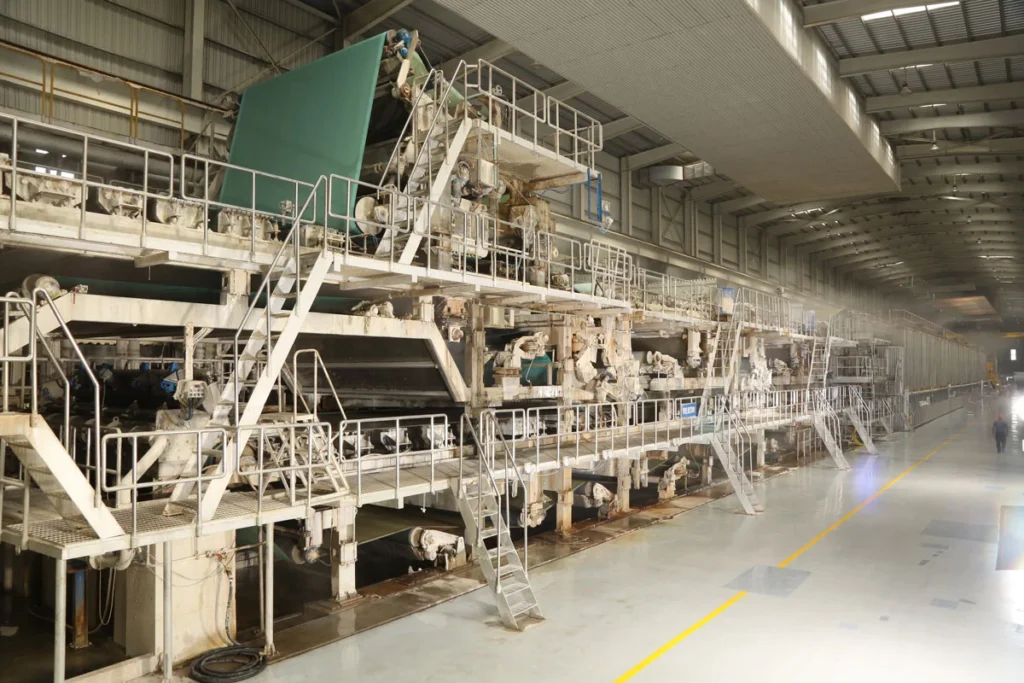 “Most common in modern board machines”
- Combination of Fourdrinier + Twin-Wire forming (Top Former)
- Top and Bottom layer formed individually, then combined with twin-wire formed middle layer.
Advantages
- Better formation
- Higher speed
- Compact layout
Major Equipment in Wire Part – Uses & Importance:
Head boxes (Top / Middle / Back)
Use:
- Deliver stock uniformly onto wire
- Control jet speed, angle, and consistency
Importance:
- Determines formation quality
- Controls layer grammage & fiber orientation
- Critical for ply bonding
Forming Wires (Fabrics)
Use:
- Support fibers while water drains
- Carry the web forward
Importance:
- Affects retention, drainage, and sheet marking
- Different mesh designs used for different layers
Breast Roll
Use:
- Supports wire at head box discharge
- Stabilizes jet landing
Importance:
- Prevents jet disturbance
- Controls initial drainage
Forming Board and Hydra foils
Use:
- Initiate gravity drainage
- Support wire under stock jet
Importance:
- Controls fiber distribution
- Prevents flocculation
- Improves formation
Foils (Low Vacuum & High Vacuum)
Use:
- Generate controlled suction for water removal
Importance:
- Improves formation
- Enhances retention
- Reduces two-sidedness
Vacuum Suction Boxes
Use:
- Remove free water after gravity drainage
Importance:
- Increases dryness before ply bonding
- Improves machine runnability
- Reduces press load
Ply Bonding Zone (Combine Point)
Use:
- Combines wet layers into a single web
Importance:
- Determines internal bond strength
- Prevents delamination
- Critical for board stiffness
Couch Roll / Couch Vacuum Box
Use:
- Final dewatering on wire
- Transfers web to press section
Importance:
- Increases solids content
- Stabilizes sheet transfer
- Improves edge strength
Save-All System (White Water Recovery)
Use:
- Recovers fibers and fillers from wire pit
Importance:
- Fiber saving
- Improves yield
- Reduces effluent load
Wire Cleaning System
Use:
- Keeps wire free from pitch, fines, stickies
Importance:
- Prevents drainage loss
- Improves wire life
- Maintains formation stability
Benefits of Multi-Layer Board Quality
A well-designed wire part ensures:
Good layer separation
Strong ply bonding
Uniform GSM profile
High bulk and stiffness
Reduced cracking & delaminatio
Stable machine runnability
“Most board quality problems (cracking, low stiffness, delamination, GSM variation) originate from wire part design or operation.”
Key Operating Parameters to Monitor
- Head box consistency (layer-wise)
- Jet-to-wire speed ratio
- Vacuum levels (foil & suction boxes)
- Wire tension
- Drainage balance between layers
- Solids before ply bonding
Conclusion
The wire part is the heart of a multi-layer board machine.
Proper configuration, equipment selection, and operating control directly decide:
- Board strength. 2. Ply bonding. 3. Surface quality. 4. Overall machine efficiency.